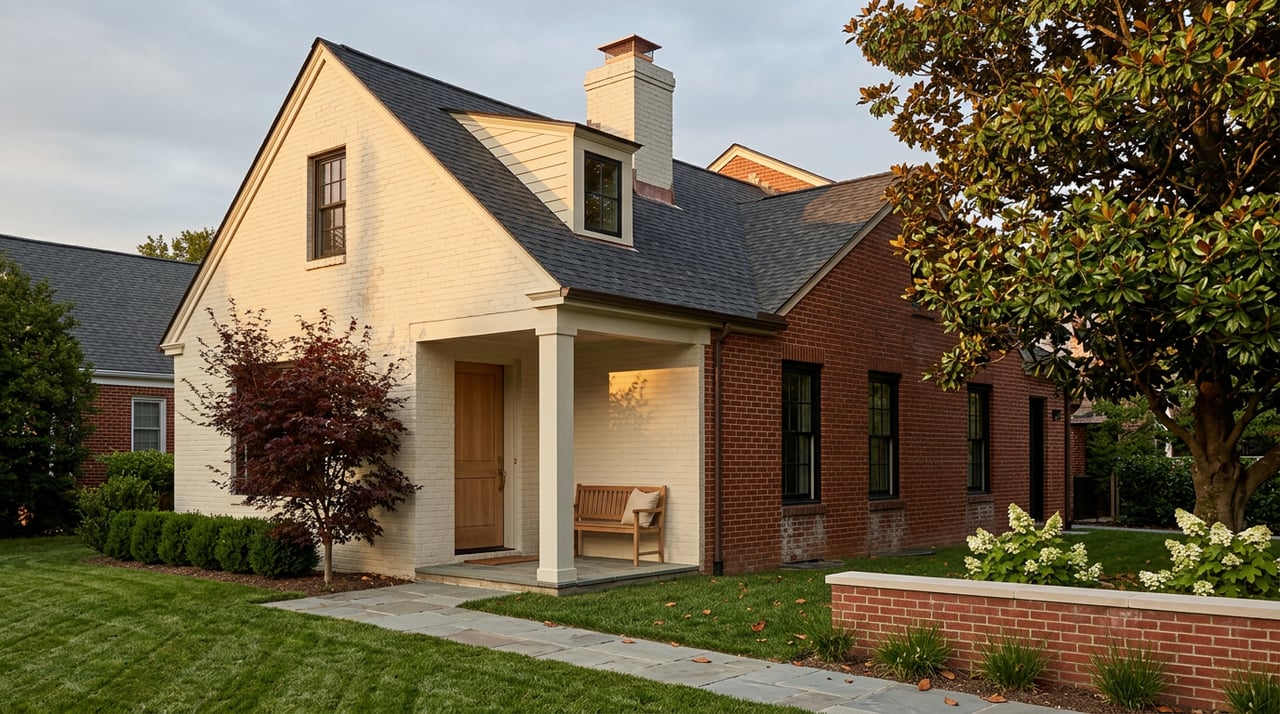
What to Know About HPR Homes in Green Hills Nashville
Drive the corner of Belmont Boulevard and Burton Avenue in Green Hills and you will see four homes where a single house used to stand. They share a driveway cut, a mail cluster, and at a glance, an architectural language: white oak floors, tall windows, the same builder-grade brick you see across a dozen other Green Hills teardown lots. On paper, though, only some of them are what most buyers assume a detached house to be. The rest are legally something closer to a condominium that happens to look like a house.
That distinction is not a rounding error. Over the trailing 12 months through June 2026, roughly 29 percent of Green Hills house closings were what local MLS data classifies as HPR-detached, meaning the home sits on a lot it shares, on paper, with one or more other homes. The remaining 71 percent were traditional site-built homes on their own separately deeded parcel. If you are shopping in Green Hills right now, that means nearly one in three homes you tour is carrying an ownership structure that behaves differently at financing, at appraisal, and at resale than the house next door.
HPR stands for Horizontal Property Regime, a Tennessee-specific legal tool created under the state's Horizontal Property Act, codified at Tennessee Code Annotated section 66-27-101 and following. In plain terms, it lets a developer take one lot, zoned for a duplex or similar density, and place two to four separately deeded homes on it without going through the city's full subdivision process. The land itself is never split into new parcels. Instead, a recorded master deed creates individual units that can each be bought, sold, and financed on their own, while the underlying ground is co-owned by all the unit owners together.
This is why you will sometimes see a Green Hills listing casually described as "the third of four homes" on a parcel, language you can find attached to a recent listing near that same Belmont and Burton corner. It reads like marketing copy. It is also a precise legal description of what you would be buying: not a standalone lot, but a fractional interest in shared ground beneath a home you fully own.
Nashville leans on this tool more than most cities its size. Research from the Mercatus Center found that among the nation's 50 largest metro areas, Nashville ranks second for the volume of recently built attached and detached single-family homes within five miles of downtown, a density boom the researchers attribute directly to the flexibility the Horizontal Property Act gives builders. Green Hills, five miles from downtown and sitting on some of the most valuable infill dirt in the county, is exactly the kind of neighborhood where that flexibility gets used.
The math is straightforward. A single 1940s cottage on a third of an acre near Estes Road or Golf Club Lane is worth one price as a renovation project. Cleared and rebuilt as two or three HPR-detached homes, each new build commands the highest price per square foot in the neighborhood, with recent new-construction sales clearing $700 per square foot. That premium is what funds the teardown in the first place.
The neighborhood's broader momentum makes that math work. Simon Property Group has confirmed a $250 million redevelopment of the Mall at Green Hills, with construction expected to begin this year and the mall remaining open throughout. Company leadership has described the project as a complete exterior transformation meant to reinforce the center's position as a national luxury retail destination, and shoppers interviewed by WSMV this June were already debating what the finished product would look like, even as mall general manager Norah Buikstra noted the property has been evolving continuously for the 25 years she has worked there. Whatever the finished mall looks like, the announcement itself has done what large announcements do to already-desirable neighborhoods. It has reinforced buyer confidence in Green Hills specifically, and confident buyers support the kind of price-per-square-foot premium that makes tearing down a cottage to build three homes on one lot financially sensible for a builder. The mall did not create the HPR boom. The same neighborhood desirability that justified a quarter-billion-dollar mall investment is what justifies the land economics behind nearly a third of the homes for sale around it.
Here is where the structure stops being a curiosity and starts being a transaction risk. Tennessee's Horizontal Property Act requires that the attorney who drafts the master deed attach a signed certification confirming the document meets every statutory requirement. If that certification is missing, the closing does not simply proceed with a note to fix it later. The master deed itself has to be amended and re-recorded, which can push a closing date by days or weeks while a seller's attorney tracks down the missing paperwork.
The homeowners association side carries its own version of the same trap. Most HPR developments are required to incorporate as a nonprofit association, and Tennessee charges a $100 annual fee to keep that incorporation active. Owners who let the fee lapse effectively dissolve their own association, which matters most for attached units that depend on that structure for shared insurance and maintenance obligations, and less for fully detached units with no shared walls. Either way, it is a detail a buyer's attorney should confirm before closing rather than after.
Monthly costs also vary more than they do for a traditional single-family home. Most site-built houses in Green Hills carry no HOA at all, or a nominal one. HPR-detached homes and the neighborhood's gated communities typically run anywhere from around $100 to $700 or more a month depending on what the association maintains. That is a real budgeting line, not a rounding error on a monthly payment.
Some lenders treat HPR properties, particularly attached configurations, the way they treat condominiums rather than detached single-family homes, which can mean additional underwriting steps or a different loan product than a buyer might expect walking in. And because new-construction HPR homes are often unique in floor plan and finish level, appraisers sometimes have fewer truly comparable recent sales to draw from, a dynamic that shows up across Nashville's infill neighborhoods whenever renovation quality or lot configuration is unusual. A buyer who assumes an HPR home will appraise and finance identically to the site-built house down the street may be setting up their own contingency period for a surprise.
None of this is happening in a soft market where a delay costs nothing. Green Hills closed 393 home sales over the trailing 12 months through June 2026 at a median price of $1,385,000, with homes selling at a 97.2 percent sale-to-list ratio, meaning the typical seller is landing within a few percentage points of asking. Days on market crept up modestly, to a median of 62 days as of June 2026 compared with 57 days a year earlier, a small loosening but not a shift that gives either side much room to absorb an avoidable delay. In a market this tight, a stalled closing over a missing attorney certification or an appraisal that came up short on comparables is not a hypothetical inconvenience. It is a real cost to whichever side is less prepared for it.
A few questions are worth asking on any Green Hills listing before you get attached to it:
None of these questions should scare a buyer away from an HPR home. Plenty of Green Hills buyers are perfectly happy with the trade, newer construction and a walkable location in exchange for shared land ownership and an HOA line item. The point is knowing which product you are actually buying before you are three weeks into a 30-day close.
Is an HPR home the same thing as a condo? Legally, they are governed by the same underlying Tennessee statute, but most Green Hills HPR homes are fully detached, single-family in appearance, and sit on their own footprint even though the ground beneath them is shared on paper.
Can you get a conventional mortgage on an HPR home? Often yes, but not automatically. Some lenders finance detached HPR units the same as any single-family home, while others apply condo-style requirements, particularly for attached configurations. Confirming this with your specific lender before you write an offer avoids a late surprise.
How can I tell if a listing is an HPR before I tour it? The listing description or public record will usually reference a master deed, a shared parcel, or language like "one of X homes on this lot." If it is not obvious, ask your agent to pull the deed before your showing rather than after your offer.
Green Hills rewards buyers and sellers who do their homework before the ink dries, not after. If you are weighing a Green Hills purchase or sale and want a straight read on what a specific listing's ownership structure actually means for your financing and your timeline, Jeanie Barrier has spent 24 years working these blocks and these closings. Let's Connect before you write the offer, not after.

Thinking about buying or selling in Nashville? With Jeanie’s local expertise and 25+ years of real estate sales experience, she’ll guide you every step of the way. Call today to get started!